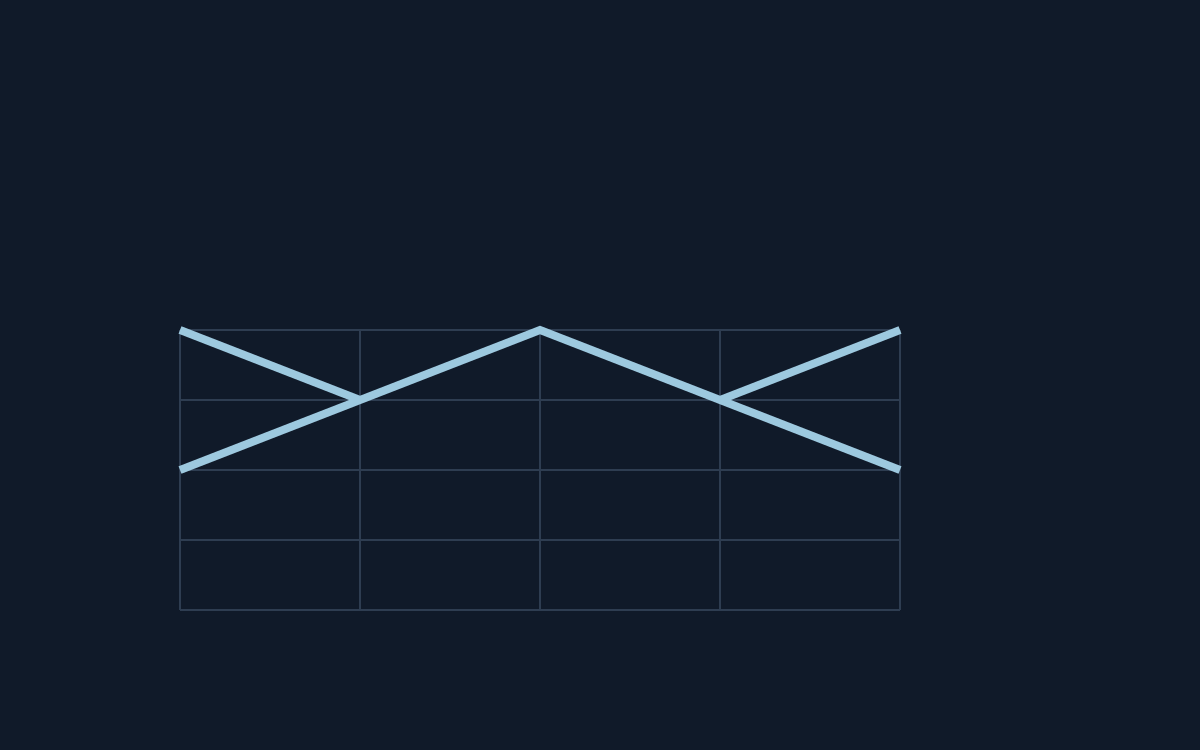
One diagonal in every cell
Slant places one diagonal in every square, with numbered points counting incident lines and a separate rule forbidding loops. A board can satisfy all its numbers yet fail because a closed diagonal route remains.
At a numbered boundary point marked zero, each neighboring cell must choose the diagonal that misses that point. This is a local orientation deduction; it does not require guessing a whole connected shape.
A boundary zero chooses a direction
At an interior point marked four, all four surrounding diagonals must meet there. That creates a cross-shaped junction, not a cycle by itself. Branching is allowed; a closed route is not.
An interior zero would force the four surrounding cells to lean away and enclose a diamond loop. The manual explains why such a zero cannot occur in the interior of a valid puzzle; boundary zeros do not have the same consequence.
Check the route before closing it
Before adding a diagonal between two endpoints already connected by other diagonals, trace their existing route. The new edge would complete a cycle, so that orientation is excluded even if both endpoint counts still have room.
Tatham’s developer account of loop detection helps distinguish the offending ring from branches attached to it. When explaining a rejection, name the closing edge rather than blaming every line in the same connected component.
Explain the forced endpoint
In Slant, find a boundary clue and state which endpoint each neighboring diagonal would meet. If you reject an orientation for forming a loop, trace the pre-existing route between its endpoints.
Export the puzzle identifier and the cell you changed through the checklist. Describe the closing edge and the observed warning; do not report a whole connected branch as the offending cycle.
Official references
References checked: . Original editorial schematic; not a captured game board.
Keep going
Browser game guides
Practical reading for players and independent makers.
Tents: count the row, then check whether every tree can still get its own tent
Tents requires row and column totals, non-touching tents and a one-to-one matching between trees and orthogonally adjacent tents. Correct totals alone do not prove that every tree can receive its own tent.
Light Up: a lit square is not automatically a safe bulb position
Light Up asks you to illuminate every white square while preventing two bulbs from seeing each other. A bulb lights along rows and columns until a black square blocks the ray; light does not turn around a corner.
Release checklist
Record manual browser-game checks and download a preparation report. No remote scan or compatibility certification.