Why GTA VI is the tempting test for AI
Rockstar's GTA VI page, checked on October 24, lists a November 19, 2026 release and links an October 15 launch-trailer announcement. That makes the game a timely reference point for a bigger question: if AI can generate a convincing street, how much of a complete open-world game has it actually made?
Our answer is a feasibility assessment, not a demonstration that an AI has recreated GTA VI. The useful distinction is between producing a scene that resembles a genre, building interacting rules you can test, and delivering a coherent experience that survives hours of player choices. Those are different achievements.
What a world model can demonstrate
Google describes Genie 3 as a model that generates environments you can explore through real-time interaction. Its current model page also names limited action space, difficulty with multiple independent agents and limited continuous interaction duration. Those are meaningful capabilities and boundaries; they do not establish that the output is a complete authored game.
A street that remains visually plausible while you drive tells you something about world continuity. It does not by itself tell you whether a mission can fail and restart, whether a purchased vehicle persists, or whether two players agree about what happened. When watching an AI city demo, ask which of those outcomes was actually shown.
The city needs rules that keep agreeing with each other
Consider an original mini-city prototype: you drive to a marker, collect a parcel, evade a pursuer and return to a garage. Even this small loop needs input, collisions, mission state, clear failure, restart and some explanation of progress. A good evaluation repeats the same task and tries an awkward action, such as returning without the parcel.
An expansive commercial release adds much more content and many more interactions. We are not assigning an invented completion percentage or budget. The practical point is that the screenshot is only one piece of evidence. A testable rule—what happens when the delivery fails—is often more revealing than another minute of attractive scenery.
Choose a smaller claim that players can verify
For an AI-assisted creator, an original driving or delivery game with one complete loop is a stronger submission than a claim to have made GTA VI. Name the systems you implemented, identify the tools you used, and give players a build they can retry. If it is only a generated exploration demo, describe it that way.
Do not treat a familiar-looking city as evidence of official assets, affiliation or access to Rockstar's game. Build your own setting and make the playable claim precise. A reader who came for GTA VI can still discover an interesting small game when the connection is explained honestly rather than promised by the headline alone.
Follow the idea into real games
Roblox's recent Build evaluation offers a useful next question: even when AI produces working systems, do players have a reason to play again? Our companion article examines that distinction. Master Blaster supplies a different kind of example: a creator-described AI-assisted project with a concrete grappling-and-combat premise.
On PixelGamesHub, use the actual game entry and creator link to judge a playable build. Creators can submit an original prototype with its current controls, limitations and specific feedback request. This article does not provide a browser version of GTA VI, and none of the linked independent games is presented as an official replacement.
Official references
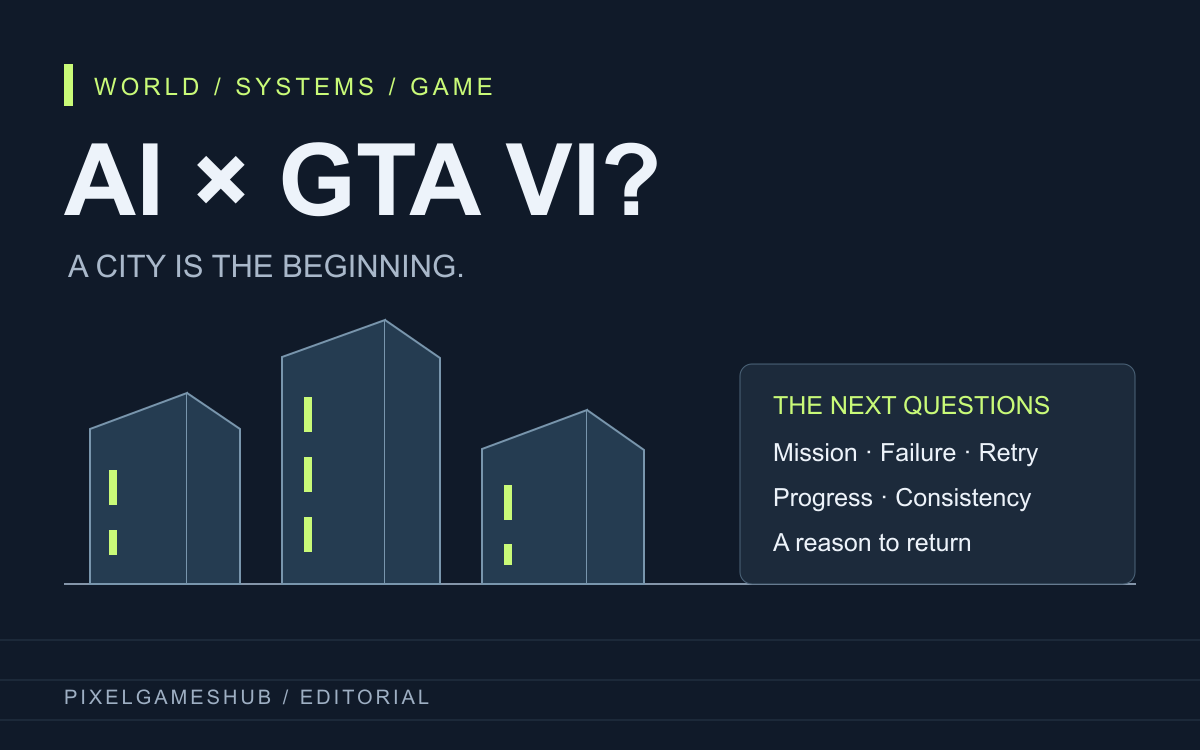
References checked: . Original PixelGamesHub editorial illustration; no Rockstar game footage or official affiliation.
Keep going
Browser game guides
Practical reading for players and independent makers.
Are AI games fun?
Read Roblox Build’s October evaluation through player decisions and reasons to replay.
Master Blaster’s maker story
Read a public AI-assisted creator account through grappling, arena combat and a real feedback request.
Share your browser game
See what you submit, what stays private, and how review differs from visibility.