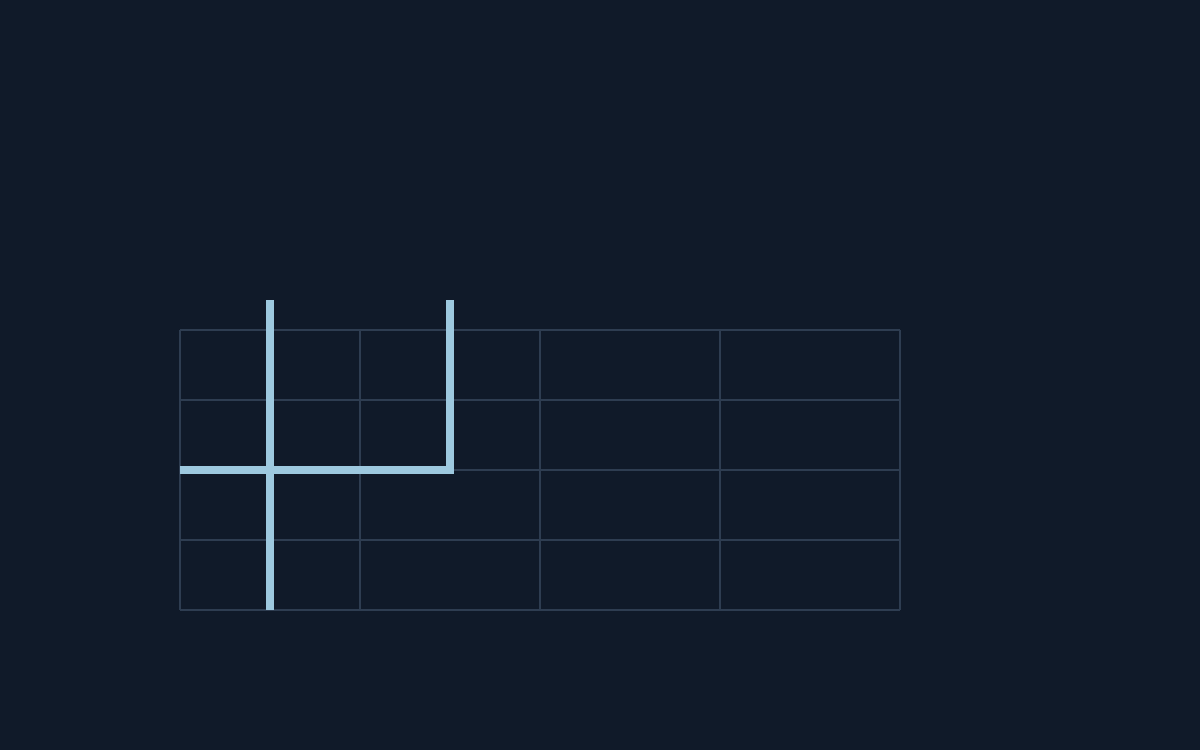
Read a ray outcome
Black Box hides balls and lets you fire rays from the boundary. A direct collision absorbs a ray, diagonal influences can turn it, and returning to the entrance is a reflection; an immediate edge influence can also count as reflection.
The interface uses H for absorption and R for reflection. Matching numbers pair a shot’s entrance and exit. A number is an identifier for that shot, not a distance or the count of hidden balls it encountered.
A reproduced three-shot observation
On November 14, our desktop Chrome check opened the fixed instance w8h8m5M5:f3afa108f9f10f0d2497a44a and fired from the first three entrances along the top, left to right. We did not reveal or solve the hidden layout.
The first paired top entrance one with bottom entrance one, both labeled 1. The second paired top entrance two with the second entrance down the left edge, labeled 2. The third top entrance displayed H.
Why a hit does not locate a ball
That H does not prove a ball sits directly beneath the third entrance. A ray can turn before being absorbed, so its final collision may be away from the original straight column. Compare observations from other directions before assigning a position.
The manual warns that configurations with more than four balls can be indistinguishable. Its checker compares ray results rather than requiring an identical hidden arrangement. A different-looking guess can therefore be accepted without implying the checker is broken.
Compare layouts by their ray behavior
For the recorded Black Box instance, the first three shots are an evidence log, not a solution. A useful next shot is one for which two candidate arrangements predict different exits; compare the actual outcome with both predictions.
The checklist can export the fixed identifier, top-entry order and paired exit labels. Keep the observed H separate from a guessed ball coordinate, so another player can reproduce the evidence without adopting your hypothesis.
Official references
References checked: . Original editorial schematic; not a captured game board.
Keep going
Browser game guides
Practical reading for players and independent makers.
Map: sharing a point is not the same as sharing a border
Map colors regions with four colors while preventing equal colors across a shared border. Two regions touching only at one point are allowed to match. Counting every visible contact as adjacency introduces an extra restriction.
Unruly: balance each line without adding a uniqueness rule the puzzle does not use
Unruly colors cells black or white with equal totals in each row and column, and forbids three consecutive cells of one color. Both dimensions must have even sizes because of that balance requirement.
Release checklist
Record manual browser-game checks and download a preparation report. No remote scan or compatibility certification.